

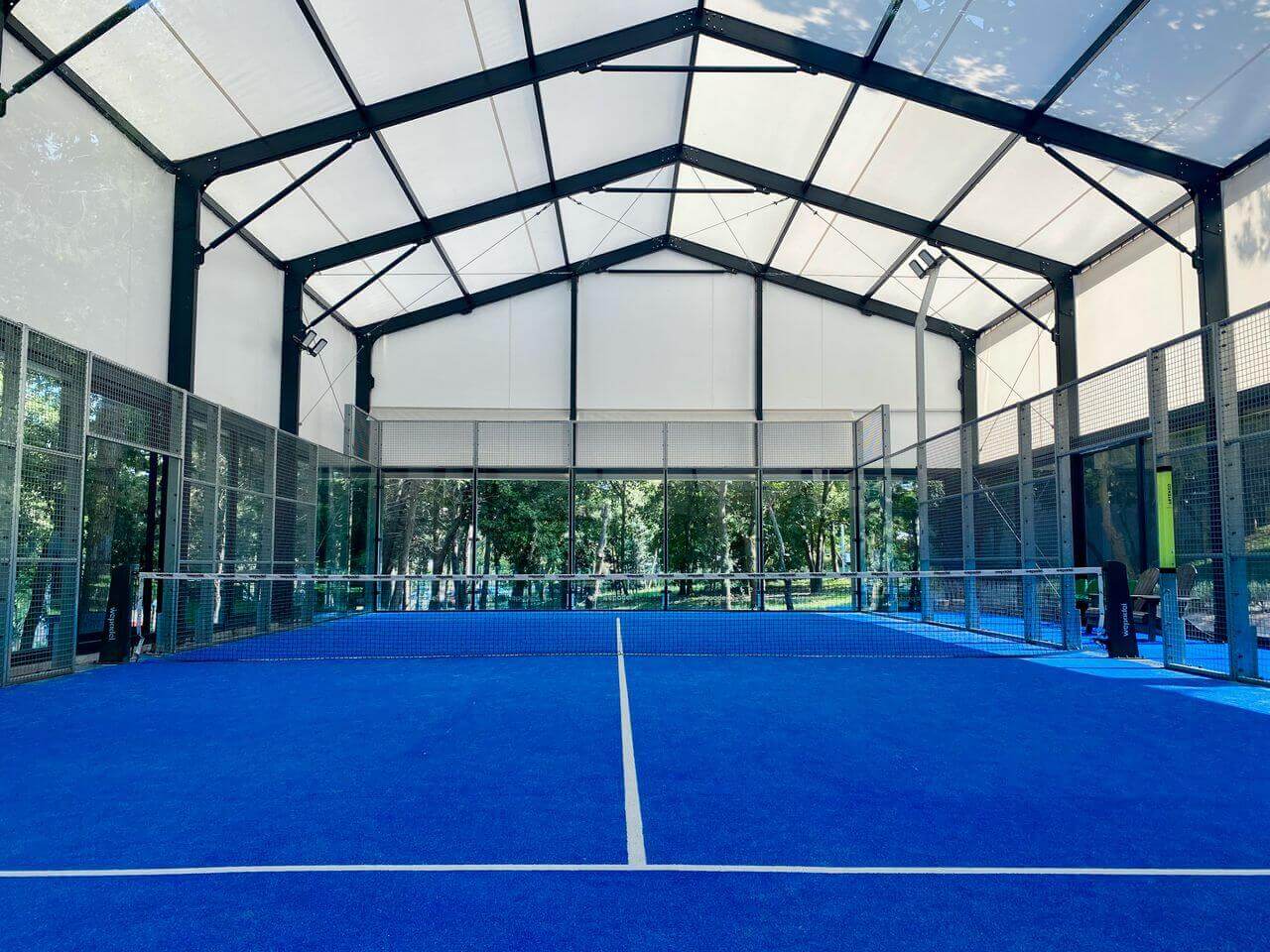
Turning tennis courts into padel courts is becoming more common across the UK and Europe. It is often seen as a way to make better use of existing sports spaces while reducing environmental impact. Instead of building entirely new facilities, clubs and councils are adapting what they already have.
This approach is not just about sport trends. It is also about sustainability, cost saving, and smarter land use.
Using existing land more efficiently
“One of the main sustainability benefits is that padel courts make better use of space that is already developed,” explains Dan Warwick, founder of Warwick Padel. “A standard padel court measures 20 metres by 10 metres, giving an area of 200 square metres. A standard tennis doubles court measures about 23.77 metres by 10.97 metres, which is roughly 261 square metres.”
This means a padel court uses around 23% less surface area than a tennis court. Because of this smaller footprint, many existing tennis sites can be reconfigured more efficiently. In some cases, two padel courts can be installed in the space of one tennis court, depending on layout and access.
This higher density of use means more players can use the same land, reducing the pressure to develop new recreational land.
How to turn a tennis court into a padel court
Reducing construction materials and carbon impact
Building new sports facilities usually involves significant construction work. This includes excavation, new foundations, fencing, lighting, and surfacing. All of this carries a carbon cost.
By converting tennis courts instead of building new padel clubs from scratch, much of this infrastructure can be reused. Existing bases, fencing, drainage systems, and even lighting columns can often be adapted rather than replaced.
This reuse reduces the need for new raw materials like concrete and steel, both of which have high carbon footprints. It also reduces waste from demolishing existing structures. In sustainability terms, reusing infrastructure is almost always more efficient than starting from zero.
Making better use of underused sports spaces
In many areas, tennis courts are not used to their full capacity. Some local authorities in the UK have reported that public tennis courts can be used at less than 50% capacity outside peak times.
Padel courts help solve this issue by increasing usage. Padel is a faster-paced, doubles-based sport that attracts players of different ages and skill levels. Because matches are shorter and courts are smaller, more games can be played in the same time period.
This higher participation rate means the same physical space delivers more social and health value without expanding its environmental footprint.
Lower long-term environmental impact
Once installed, padel courts generally require less maintenance than traditional tennis courts. The enclosed design helps protect the playing surface from weather damage, which can reduce the need for frequent resurfacing.
Resurfacing a tennis court typically involves new asphalt or acrylic layers, which carry both financial and environmental costs. If a converted padel court reduces the frequency of major resurfacing, the long-term carbon output of maintaining the facility can also be lowered.
Energy use is another factor. Because padel courts are smaller, they can be lit more efficiently. Some facilities report that lighting demand can be reduced simply due to the reduced court area, even if more courts are installed overall.
Supporting sustainable urban development
Sustainability is not only about materials and energy. It is also about how communities use space. Converting tennis courts into padel courts supports compact, multi-use sports hubs instead of expanding into greenfield land.
This approach aligns with wider planning goals in the UK, where there is increasing pressure to protect green space and reduce unnecessary new construction. By upgrading existing sports facilities, councils and clubs can meet growing demand for sport without increasing land consumption.
Conclusion
Converting tennis courts into padel courts is a practical sustainability strategy. It reduces the need for new land, lowers construction demand, and improves the efficiency of existing sports spaces.
With a smaller court size of 200 square metres compared to about 261 square metres for a tennis court, padel already makes better use of space. Combined with higher usage rates and reduced redevelopment needs, it is a clear example of how sports infrastructure can evolve in a more sustainable direction.
